v3.1.0 · VST3 & Standalone · pluginval strictness 10

See what your mix
is really doing.

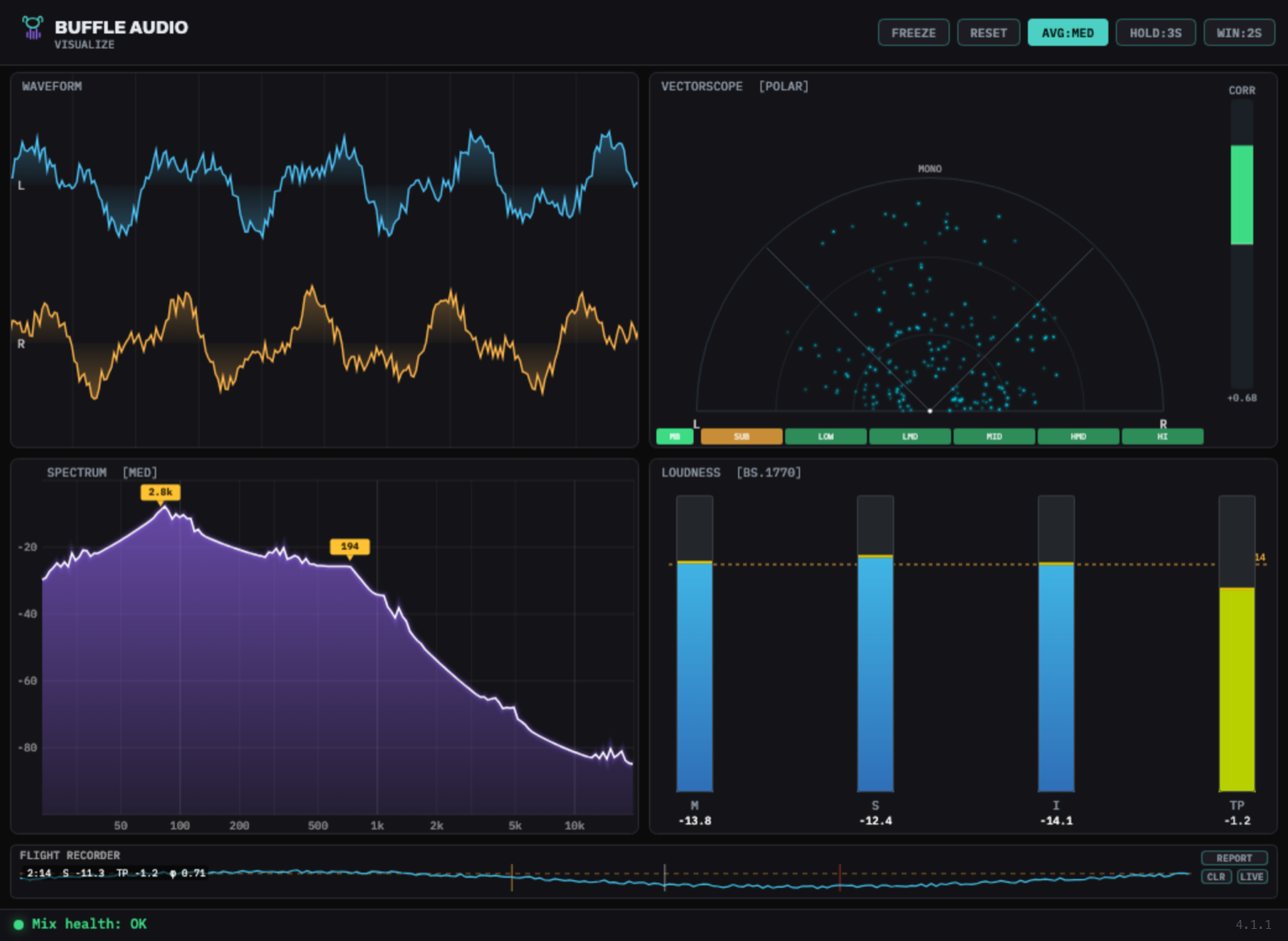
A professional real-time audio analyzer — waveform, vectorscope, spectrum and loudness in one responsive view — with six decision-support features that turn measurements into answers. Analysis-only: your audio passes through untouched, at zero latency.

Download for macOS See it live ↓ MIT · built on JUCE 8
Buffle Audio · Visualize FREEZEAVG·MED HOLD·3SWIN·2S
Mix health: OK 3.0.0
Four analyzers, one view

The instrument

A responsive 2×2 grid you can resize from compact to full-screen. Every panel updates in real time and explains itself on hover.

Waveform

Stereo waveform

Left in cyan, right in amber, with a gradient fill and a 2 / 5 / 10-second window. 60 fps.

Vectorscope

Stereo image

Click to switch between M/S Lissajous and an Ozone-style polar dome. Smoothed correlation meter.

Spectrum

FFT frequency analysis

4096-point FFT, log 20 Hz–20 kHz, 4.5 dB/oct tilt so mixes read flat, peak-hold frequency tags.

Loudness

Broadcast metering

ITU-R BS.1770-4 LUFS (M/S/I, gated), 4× oversampled true peak, EBU LRA, −14 LUFS target line.

Beyond metering

Six features that answer questions,
not just display numbers

Every analyzer shows you data. These turn the data into decisions — and no competing analyzer combines them.

01

Band-Split Stereo Guard

Correlation per 6 frequency bands, plus a dedicated mono-bass alarm — catch out-of-phase lows before they vanish on club and vinyl systems.

02

Reference Corridor

Load up to four reference tracks. Instead of chasing one curve, you get a min–max tolerance band — stay inside the corridor of great masters.

03

Translation Lens

Preview your mix through a phone, earbuds, a car or a club — the analysis re-weights, the audio never changes. See what survives on each system.

04

Mix Health Feed

A rule engine watches every metric and tells you what's wrong in plain language, with a severity dot in the footer and a timestamped feed.

05

Flight Recorder

Logs the whole session at 10 Hz. Scrub the timeline to read any moment, then export a self-contained HTML mix report to hand off or archive.

06

Masking Radar beta

A Bark-scale estimate of which frequencies are perceptually buried by louder neighbours — it names the masker so you know exactly what to carve.

Screenshots

Every panel, populated

The actual interface — rendered from the plugin's exact colours, layout and states, with signal flowing through every analyzer.

Buffle Audio Visualize — full interface: waveform, vectorscope, spectrum and loudness in a 2×2 grid
Spectrum with tone-match reference corridor
Tone matching — a reference curve and its min–max corridor over the live spectrum, with peak-frequency tags.
Masking Radar highlighting a buried frequency region
Masking Radar (beta) — the buried region highlighted, with the dominant masker named.
Vectorscope polar dome with correlation meter and band strip
Vectorscope — Ozone-style polar dome, correlation meter, and the per-band stereo strip with mono-bass alarm.
Mix Health Feed listing plain-language findings
Mix Health Feed — every metric watched, issues explained in plain language with a severity feed.
Under the hood

Specifications

Formats
VST3 · Standalone
Platform
macOS
Latency
0 samples
Sample rates
44.1 – 192 kHz
Processing
32-bit float
FFT
4096-pt · Hann · 75%
Loudness
BS.1770-4 · EBU R128
True peak
4× oversampled
Framework
JUCE 8.0.7
UI
400×300 – 1200×900
Validation
pluginval L10
License
MIT

No network, no data

Zero telemetry. File access is limited to a reference you choose and a report you save.

Transparent audio

Analysis-only. Samples pass through bit-for-bit with zero added latency.

Validated strictly

Passes pluginval at strictness 10 — the strictest setting — every release.

Open & auditable

MIT-licensed source with a dedicated auditor's guide and architecture docs.

Get it running

Install or build

Install (macOS)

  1. Download BuffleAudio-Visualize-3.0.0.pkg from Releases.
  2. Open it — right-click → Open if Gatekeeper warns (the package is unsigned).
  3. Pick components: VST3 → plug-ins folder, Standalone → Applications.
  4. Load it on any stereo track, bus, or master.
Go to Releases ↗

Build from source

# regenerate the Xcode project from the .jucer
JUCE/Projucer.app/Contents/MacOS/Projucer \
  --resave WaveformVisualizer/buffleaudio_visualize.jucer

# build the Release VST3
cd WaveformVisualizer/Builds/MacOSX
xcodebuild -configuration Release \
  -scheme "buffleaudio_visualize - VST3" build

# or build the whole installer
./Installer/build_installer.sh